
The human decision-making process is simple in one respect: All decisions are emotional. In another respect it is just as complex: We require rational motives to motivate our decisions driven by emotions.
In simplified terms, decision-making can be mapped in two dimensions. First, customers’ decision-making depends on how important the product or solution is to them. The more important they believe the product is for their business, the more actively involved buyers are when deciding. This forms the x-axis of the matrix with important decisions to the east.
The second dimension defines the main driver for the decision, forming the y-axis. In one extreme customers decide in order to maximize the outcome of the purchase (north), in the other extreme they decide to minimize their business (and personal) risk.
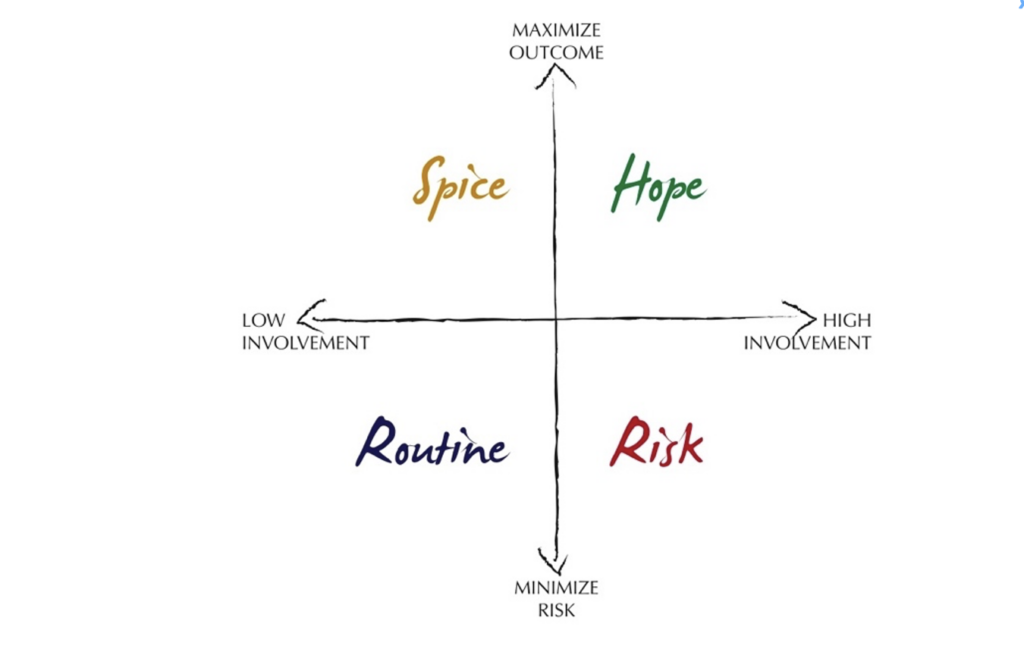 Depending on the perceived importance of the product and what drives the decision-making, the brand is bought as one of four decision categories.
Risk decisions
This applies to purchases requiring substantial investment, which means that you run a risk of losing something – money, status or work. Some would like to believe that it all comes down to a rational decision, but no. This is this the type of decision that makes customers defensive due to the fear of losing.
Consequently, the decision takes a while longer to make, and customers usually seek information from many sources before reaching the decision to buy. Furthermore, risk-oriented decisions are characterized by customers not seeking the optimal solution, but the solution they believe everyone involved can most likely accept.
A typical example is SAP. The ERP system is a critical function for the company, it can basically stop it. So, if you buy the best/most expensive system, no one can say it was a bad choice.
How you should act
Broad brand awareness and knowledge, and a generally good reputation, are key success factors. The aim is to make customers feel secure and to provide winning arguments for their decision to buy. It is also important to make customers feel smart, and to help them rationalize and verbalize their choice to others.
One possible strategy is to move the decision towards hope, ie emphasis the positive effect from choosing our solution in addition to frame it as safe. A fantastic example of this is how IBM’s competitors attacked the “You never get fired if you buy IBM” ad. They put a copy of the ad plus the headline “But you will never get promoted either…”
Hope
Here we are talking about brands and products that offer significance to customers. These are brands and products that customers make their own. The choice is, in other words, often based on the image customers want to create for themselves.
Apple is a typical example. Think differently gives you the hope of becoming better and looking smarter at your work than you would have been with a normal PC or an Android phone.
How you should act
Reputation, differentiation and a clear belief and/or standpoint are key success factors here. The challenge is to transform the brand and/or product into a relationship that creates loyalty beyond reason. Here the argumentation must be quite emotional since we want to make the customer so proud of choosing our solution that he/she will tell it to others.
Routine
This category is characterized by defensive, low-involvement products. Customers won’t invest time and effort in these smaller decisions, which is why they decide once and then just follow the routine. The choice is characterized by security. Customers know what they’re going to get, so why take a chance on something new and unknown?
Many low-priced brands use this argumentation for standardized products. “Very similar performance, why pay more” is a typical reason why you should not spend time to investigate and do an active choice.
How you should act
The challenge is to break the behavioral pattern, i.e. to break though the perceived boredom of the choice. To succeed, one must do or claim something unexpected. Customers must be motivated to bother.
One way to do this, is to “complicate” the decision, ie underline the risks of going with the cheaper solution and thereby moving to a risk decision. Creating a guide with “XX things to consider when choosing” can be one way to highlight all aspects and the potential cost of not looking into them.
You can also change the feeling of good enough by, for instance, giving free samples, free trials and/or heavy introduction discounts. Another way is to build a very strong brand personality.
Spice
This type of decision deals with brands and products that customers choose to decorate their life/business with, in order to add a little style and zest. The product itself is not vital or central for the buyer but it can add (or reduce) spice with regard to how customers are perceived by their customers.
The psychological driving force is the question of which brand or product provides customers with most value in this respect. The choice is often governed by spontaneous pleasure or satisfaction. The price is seldom a great obstacle, as most of the brands in this category are chosen as an alternative to more generalized brands and/or products.
There are few B2B examples in this category. Airlines sometimes use it to promote “you are worth a business class trip” backed up by rational arguments like “work more and better”
How you should act
The challenge is to get customers to desire the product, and preferably to want it here and now. Creating buzz, “hyping” the product, is one way. For ”selected customers only” is another. Apart from this, in order to succeed, the product needs either an obvious price advantage or considerable originality and feeling (preferably both).
If you want to discuss communication that makes potential customers act in the way you like, you are always welcome to contact ulf@sfinxagency.se