
Defining a brand’s personality or character is sometimes perceived as advertising industry hocus-pocus. One reason is probably that it feels difficult to apply the theory in practice. But the fact is that a fitting brand personality very often can be the decisive, differentiating factor in creating preference for your brand, as well as long-term and profitable customer relationships.
Brand personality refers to the character traits that the target audience associates with your brand. In other words, it is about conveying emotional associations, not rational ones. The whole point of brand personality is to add a differentiating dimension to your brand that the product alone cannot convey. This will strengthen customers’ emotional relationship with the brand, which in turn strengthens preference and loyalty.
The model we normally use in customer projects is called “Brand archetyping,” as it is based on the archetype theories of the Swiss psychologist Carl Jung from the early 20th century and then developed by different brand experts.
An archetype is a so-called primordial type – an inherited way of thinking and feeling. Archetypes can therefore be described as characters that all people, regardless of origin and culture, have the same associations with. All fairy tales, myths and legends – from all times and parts of the world – contain the similar archetypes. Archetypes are thus a shortcut to our associative patterns. The film industry uses archetypes successfully, because clear archetypes simplify storytelling.
The same spontaneous and unconscious patterns of association can advantageously be used to convey a brand’s personality. The story that each archetype represents – for example, “the Hero,” “the Rebel,” “the Magician,” or “the Ruler” – can thus be borrowed to form the foundation of the personality and the story you want to connect to your brand. In the figure below, you get an overview of the principle and some examples of brands that have positioned themselves clearly.
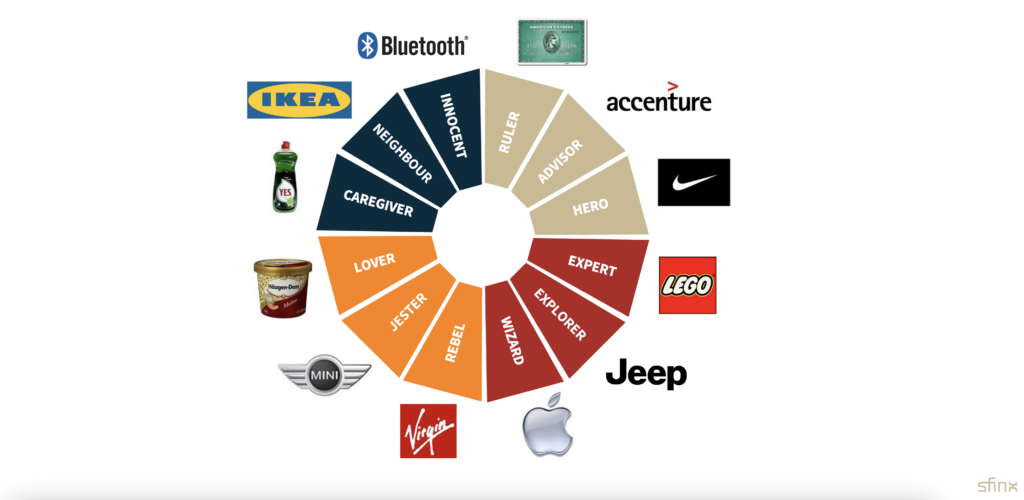 One company that has truly succeeded is Virgin. From the very beginning, Richard Branson declared that Virgin would act as “the Robin Hood of business.” No matter where in the world any of his hundreds of thousands of employees encounter a problem, they can always think, “What would Robin Hood do?” Naturally, the archetype also guides communication. Virgin is red and always argues as a challenger (or rebel/outlaw…) against the market dominant player.
Brand personality is probably even more important in B2B, where the sales and service organization often need support in how to act and argue in sales situations. If everyone interacting with customers in sales, delivery, service and support acts in a consistent way, it creates a powerful relation to the customer.
Does this sound interesting? Just reach out to ulf@sfinxagency.se