
Here are a few examples:
1. Framing
How do you best sell a sweater for 3,000 SEK? Hang it next to a similar sweater priced at 13,000 SEK – suddenly, the first one seems like a bargain.
Framing means creating expectations and reference points in the potential customer’s mind that shape their perception — for instance, of price.
Companies that use this technique to the fullest include hotels.com and other hotel booking sites. No matter what you choose, you’ll often see a message like: “Many people want to stay in Copenhagen this weekend. Please consider another date.” That’s usually not even possible, but once you start looking at rooms, you expect them to be more expensive than you initially expected (and it’s “your own fault” for choosing the “wrong” weekend).
2. Decoy pricing
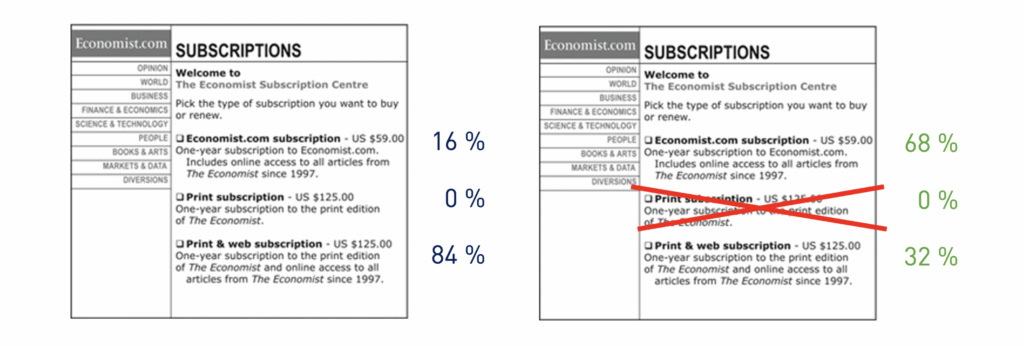
If one chair costs 500 SEK and another costs 600 SEK, most consumers — assuming equal quality — will pick the cheaper one. But if we add a third chair of similar quality priced at 750 SEK, which would you choose? If you’re like most people, you’d probably pick the one for 600 SEK.
By introducing a premium option, you actually sell more of the middle option. Another classic example comes from The Economist, which once ran a very odd subscription ad. The middle option might seem pointless — but it had a very important role. It made the premium option look cheap and increased sales by over 40%vin an A/B test where it was removed.
3. The magic number
You would think we all realize that 99 SEK is basically the same as 100 SEK – yet there’s something magical about the number 9. Studies on “9-pricing” show that it increases sales by an average of 24%. Even more interesting: research shows that you should write sale prices in smaller font size and put the price below the product. Our brains associate physical size and placement with numerical size, so the price appears lower when it’s small and placed lower.
4. Price perception
If you’re selling something that lasts a year for 365 SEK and you phrase it as “only one krona per day,” it sounds much more appealing than “buy a year’s supply for 365 SEK.” The same principle applies when offering discounts, such as in a campaign. Suppose the normal price is 100 SEK per product, and you let customers buy three for 200 SEK — the way you present this offer will have a major impact on your brand:
- Buy 3 products, 33% off!
→ You come across as cheap and risk falling into a discount trap. - Buy 3 products, pay for 2!
→ Slightly better – feels less like a discount. - Buy 2, get 1 free!
→ Now the discount feels more like a reward — you pay full price for two products and get one extra as a bonus.
If you want to discuss how creative pricing can improve your profitability, reach out to ulf@sfinxconsulting.se