
It’s empirically proven that roughly a 50/50 split between brand building (long-term) and activation (short-term) can double the result from your investments in marketing. Still, few marketers seem to accept this – which opens great opportunities for companies that put trust in data and research, also in this field.
In the IPA study named “The Long and the Short of It”, Les Binet and Peter Field concludes that successful marketing requires a strategic balance between long-term brand building and short-term sales activation. The “short” refers to immediate, tactical campaigns focused on sales, while the “long” refers to branding efforts that build long-term value and profit. The report’s key finding is that the most effective marketing integrates both, suggesting a long-term investment in brand-building delivers double the profit of a short-term approach alone. If you want to hear it from Les Binet himself, you find a presentation here.
Most CMO’s I meet agree with this. Still, more and more of the marketing budget is moved to short-term activities. According to a recent WARC study, in 2023 the split was 59.9% investment in short-term activities vs 40.1% in long-term. In 2024 this has moved to 68.8% vs 31.2%, ie a significant jump in the “wrong” direction. Why? I think the easiness to measure results is the key. It has become so important to show specific numbers, that many forget why we work with marketing.
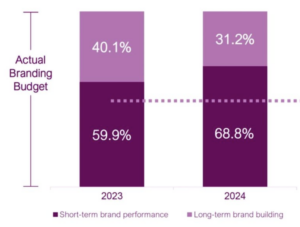
Even if the exact split between long-term vs short-term varies between industries, there is a good basic logic behind it. Most companies in the world want to sell this year, but also next year, in 10 years time, etc. This is one reason why long-term brand building activities are important if you have a long-term perspective for your business.
A fair discussion though is what “brand building activities” really means. In B2B, where sales cycles normally are long, there is probably less difference between the activities. In B2C, short-term activation is often “Buy now. Get X% discount”, which is rarely seen in B2B.
In B2B, the big challenge in my opinion is to remember the 95-5 rule, ie that the majority of potential customer are not in the market now. We can not target this group with “convert now” communication, simply because they are not prepared to convert. Instead we must create mental availability by providing insights, ideas and inspiration.
So, when you plan your next campaign or launch – always include a long-term part with assets and channels where conversion is not the main KPI. Then you are off fine – in both the short and the long.
If you want to discuss real effect of your marketing, let’s have a chat. Reach out to ulf@sfinxconsulting.se