
Positioning is probably the most important marketing and sales strategy. It is the difference between being perceived as credible and unique or just being another option. One critical aspect of positioning is brand extension, ie can the brand be used for different offerings.
Some experts argue that if a brand spreads across categories, the customers become confused.
But others argue: if we have a strong brand, why not make use of it in areas where it can add value? And some brands have succeeded. Apple, for example, is successful as a producer of both computers, mobile phones and a lot more. And Apple can probably start producing cars as long as it has smooth design and intuitive operation. In the B2B sector brand extension is quite common since the company often is the brand. Sandvik, as an example, is a world-leading brand in as different areas as cutting tools and mining equipment.
Different brands can have different characteristics. We normally divide them into four groups, or levels in a pyramid:
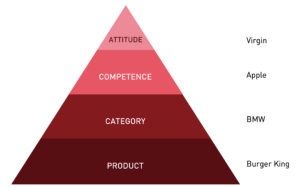
A: Product brands
Most brands are pure product brands, meaning they represent a specific product or service. This is true for most consumer brands, like Burger King that is known for “grilled burgers, but also for many B2B companies. Höganäs AB is metal powders. Perstorp AB is speciality chemicals. Etc. And they should think carefully before leaving the category.
B: Category-based brands
Some brands are instead based on a category rather than a single product. Many car brands have a broad portfolio, but share a unified profile within their category. BMW represents “driving pleasure,” whether it’s a small sports car, a large SUV or even a bicycle. Other examples of category-based brands are Volvo (safety), Nordea (financial services) and Bain (management consulting).
C: Competence-based brands
Some brands are anchored in a particular competence or technology that can be applied across many products or service areas. Apple’s success, as mentioned, lies in its ability to design functional and attractive solutions with elegant user interfaces across products.
D: Attitude-based brands
Finally, and least common, are brands that represent an attitude rather than a category or competence. The best example is probably Virgin. It began as a record store but is today also an airline, mobile company, soft drinks and trains – just to mention a few. The unifying theme is that Virgin always challenges a market leader perceived as complacent and tired.
Of course, these levels are not watertight compartments. Many companies like to claim they have competence that should allow them to extend their brand. But it’s not necessarily better to be higher up in the pyramid. If you have a clear and attractive product advantage it can be just as effective and profitable to defend the specialist role.
The higher up in the pyramid you want to be, the greater the demand for consistency across all levels in the company. That means not only in the function of the product or service, and not least in your storytelling. Virgin as an example is Richard Branson, pure and simple…
Do you want to know more about how to position yourself to win new customers, just reach out to ulf@sfinxconsulting.se