
The Illusion of Effort is the idea that we tend to value products more when we believe significant effort has gone into creating, acquiring or maintaining them. Whether it’s rating a handcrafted item more highly or downloading a 50-page white paper – we get a sense of depth and diligence, elevating both trust and appreciation for the effort made.
One interesting case is Dyson who proudly promoted that they tested 5,127 prototypes before building the perfect vacuum. Another way to convey professionalism is Domino’s Pizza, who offers customers a livestream feed of their pizza being made.
The Illusion of Effort is closely linked to a bias known as the Reciprocity Principle, a psychological phenomenon where people feel a natural tendency to replicate and return kindness or attention. In other words, we often respond to a positive action with another positive action.
The Illusion of Effort relies on the visibility of human engagement and time spent — but what happens when AI is introduced? Does perceived effort drop when buyers are told a product is powered by machine learning? Do buying committees question the authenticity or quality of work from a consultancy using ChatGPT to give advice?
To find out whether AI weakens the effect of the Illusion of Effort, the survey team recruited 500 B2B buyers worldwide and split them into three equal groups. Each group was shown the same social media advert from a fictious cybersecurity brand called Titan Systems.
- Group 1 was told the ad took 10 minutes to create using AI
- Group 2 was told the ad took one week to create by a London-based creative team
- Group 3 was told the ad took over three months to create by a London-based creative team in collaboration with a Japanese origami expert.
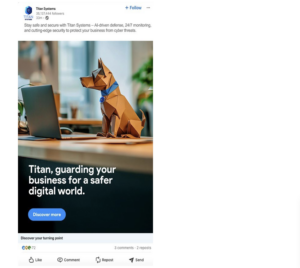
Although all groups viewed the same advert, perceptions of the Titan brand varied significantly.
Group 1, who saw the ‘low-effort’ AI version, rated the brand notably lower in appeal, trust, and innovation — only 38% reported trusting the brand.
In contrast, 59% of Group 3 who viewed the ‘high-effort’ origami version expressed trust — that’s a 55.26% uplift in perceived brand trust.
This demonstrates the Illusion of Effort bias: when people perceive greater human effort behind a message, they attribute higher value and credibility to the brand. Conversely, low-effort cues — such as AI-generated content — can diminish brand perception.
In B2B, we often strive for speed and simplicity — the promise of seamless transactions and efficient solutions. But buyers are complex. When something feels too fast or too easy, it can seem cheap or rushed.
For B2B marketers, this is a cue to pull back the curtain and become more operationally transparent. Let audiences see how your product is built, the hours of testing and the team’s dedication. It will create a sense of trust and credibility and will reassure buyers that they’re getting real value.
APPLYING THE ILLUSION OF EFFORT
Here are a few ideas for applying the Illusion of Effort to marketing strategies or campaigns to strengthen brand credibility, and perceptions of quality and care.
Behind the build campaigns
Show the real, human process and behind-the-scenes effort that went into developing your brand or products — whether it’s hand-drawn scamps, post-it notes on the wall, or the early prototype plans. Use captions like “This took 17 versions to get right” Or “3 years of team effort” to make the final output feel more valuable.
Humanize the AI stories
If AI features heavily in your value proposition, then pair it with stories of human ideation, oversight, iteration, or collaboration to restore the sense of effort. Introduce the product team, data scientists, or strategists who shaped the AI and share their thinking, challenges, and the human judgements they made.
AI + Human attribution tags
In content or product UI, visually tag what was generated by AI vs. what was refined or approved by a human. Use icons, colour coding, or side-by-side comparisons. Add microcopy like “AI-drafted, human-edited” or “Human insight, AI-scaled.” It transparently shows effort and reinforces the value of human input.
| |||||
The study and report are presented by Transmission, one of the major B2B agencies in the world, working in partnership with behavioural scientist Richard Shotton and global research agency NewtonX.
Do you want to know more about how to win new customers, just reach out to ulf@sfinxconsulting.se